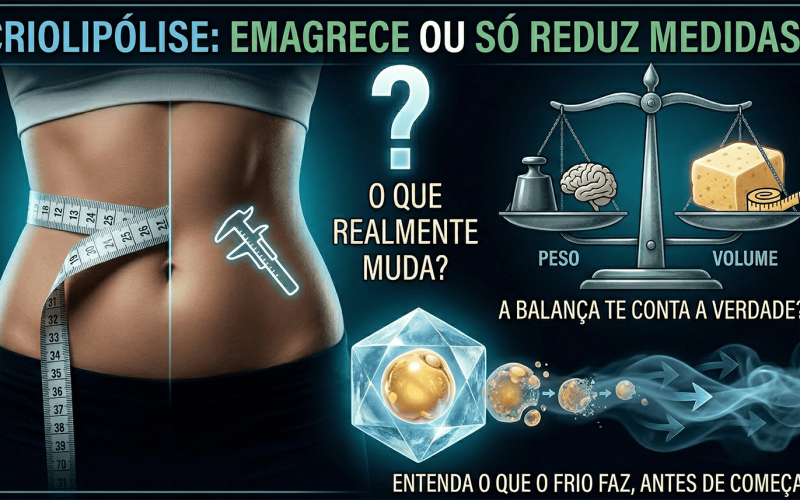
The answer may surprise you, and understanding this difference is essential for setting realistic expectations and achieving satisfying results with the treatment.
This is, without a doubt, one of the most frequently asked questions we receive from people interested in cryolipolysis. And the honest answer is: both, but in different ways. To understand why, we first need to talk about what the procedure actually does to your body.
What does cryolipolysis actually do?
Cryolipolysis is a non-invasive fat-reduction technique that uses controlled cooling to destroy localized fat cells. The device places applicators (or suction cups) on the targeted area and applies temperatures between -5°C and -10°C for 35 to 60 minutes. Fat cells (adipocytes) are more sensitive to cold than the surrounding tissues, which is what makes the procedure possible.
When exposed to intense cold, fat cells undergo apoptosis, or programmed cell death. In the days and weeks following the session, the body’s lymphatic system naturally eliminates the remnants of these cells. The result? A reduction in fat volume in that specific area.
So why might the scale not change?
Here’s the part that confuses many people. The fat cells destroyed by cryolipolysis have considerable volume but a relatively small weight. Fat is the least dense tissue in the human body. This means you can lose significant inches from your waist, abdomen, or thighs without the scale showing a noticeable change.
Think of it this way: a wet sponge and a dry sponge may weigh about the same, but they occupy completely different volumes. Localized fat works in a similar way—it takes up a lot of space, but it doesn’t weigh as much as it seems.
Cryolipolysis is a body contouring procedure, not a weight-loss method in the traditional sense. It reshapes the silhouette, reduces volume, and refines contours—regardless of the number on the scale.
Myths and facts: what is true about cryolipolysis?
Cryolipolysis causes rapid weight loss, and I will see results on the same day.
The process of eliminating the cells is gradual. Visible results appear between 4 and 12 weeks after the session, with the maximum effect usually at around 3 months.
If I gain weight afterward, the effect disappears completely.
The destroyed fat cells do not come back. However, the remaining cells in the treated area, and throughout the body, can increase in size if there is weight gain.
Cryolipolysis replaces diet and exercise.
The procedure is a powerful complement to a healthy lifestyle, especially for fat that is resistant to diet and exercise. It is not a substitute.
A single session completely transforms the body.
The ideal number of sessions varies from person to person and by area. Many protocols indicate 1 to 3 sessions per area for optimized results.
Who is cryolipolysis most suitable for?
Cryolipolysis is most effective in very specific situations. The ideal candidate profile is someone who already maintains a healthy or relatively stable weight but struggles with localized fat deposits that are resistant to diet and exercise. The most commonly treated areas include the abdomen, flanks (“love handles”), back, inner thighs, knees, and submental area (double chin).
For people with overweight or obesity, the procedure can be part of a broader body transformation plan, but isolated results will be more subtle. In these cases, a combined approach with nutritional guidance and physical activity significantly enhances the results of cryolipolysis.
Does cryolipolysis produce effects similar to bariatric surgery?
If you are looking to see the number on the scale drop dramatically, cryolipolysis is probably not what you are expecting, and any serious professional will be honest about that. However, if your goal is to lose inches, define body contours, and eliminate that stubborn fat that does not go away with exercise and a balanced diet, then the procedure may be exactly what you are looking for.
The best way to find out whether it is suitable for your case is through an in-person evaluation. Every body is unique, and a personalized protocol makes a significant difference in the final result.
Cryolipolysis in Fortaleza | Does cryolipolysis lead to weight loss or just reduce measurements?